A number you don't call from is invisible to you and disposable to your carrier. That's a bad combination when the number is the one holding up your bank, your Apple ID, and half your logins.
If you keep a separate SIM for two-factor codes — or a cheap prepaid line you only handed to your bank and a few important accounts — this is the one worth protecting. And it's the one quietly counting down right now.
The trap: low use, high stakes
Carriers measure whether a prepaid number is "yours" by activity. Stop using it and the clock starts; let it run out and the number gets suspended, then recycled, then handed to someone else. (The full timeline is in what happens when you stop using a prepaid SIM.)
Now think about which numbers you actually leave idle. Not the one you call and text on all day. It's the quiet ones: the SIM dedicated to security codes, the second line you gave your bank, the number tied to a crypto exchange you check twice a year. You keep them because they're important, and you never use them because they're important. So they're exactly the ones that lapse.
What actually breaks when the number goes
Losing the number isn't the damage. The cascade is.
- Banking: codes texted to a dead number never arrive. Some banks make phone-based recovery the only door, and now it's locked.
- Apple ID / Google: account recovery and trusted-number checks lean on SMS. Lose the number and recovery gets much harder.
- WhatsApp: it keeps running while installed, but the day you reinstall or switch phones it wants an SMS code to that number — and there's no number to send it to.
- Everything else with "text me a code": crypto exchanges, government portals, work logins.
The worst case isn't just losing access. A recycled number gets reassigned to a real stranger — who can then receive codes and reset links meant for accounts you forgot were tied to it.
Why reminders and carrier apps don't cover this
A plain reminder tells you a date is coming. It can't perform the action, it doesn't know what your specific carrier counts as activity, and it's the easiest thing in the world to snooze for a number you never think about.
Carrier apps don't solve it either. Each one watches a single line on a single account. If your important numbers are spread across two carriers — say a home-country SIM and a local one — no single app sees them together. The number you most need to watch is usually the one with no app watching it.
Keep the invisible SIM visible
The fix for a low-frequency, high-stakes chore is to make it impossible to forget. Give each important number its own countdown, and put the at-risk ones somewhere you already look.
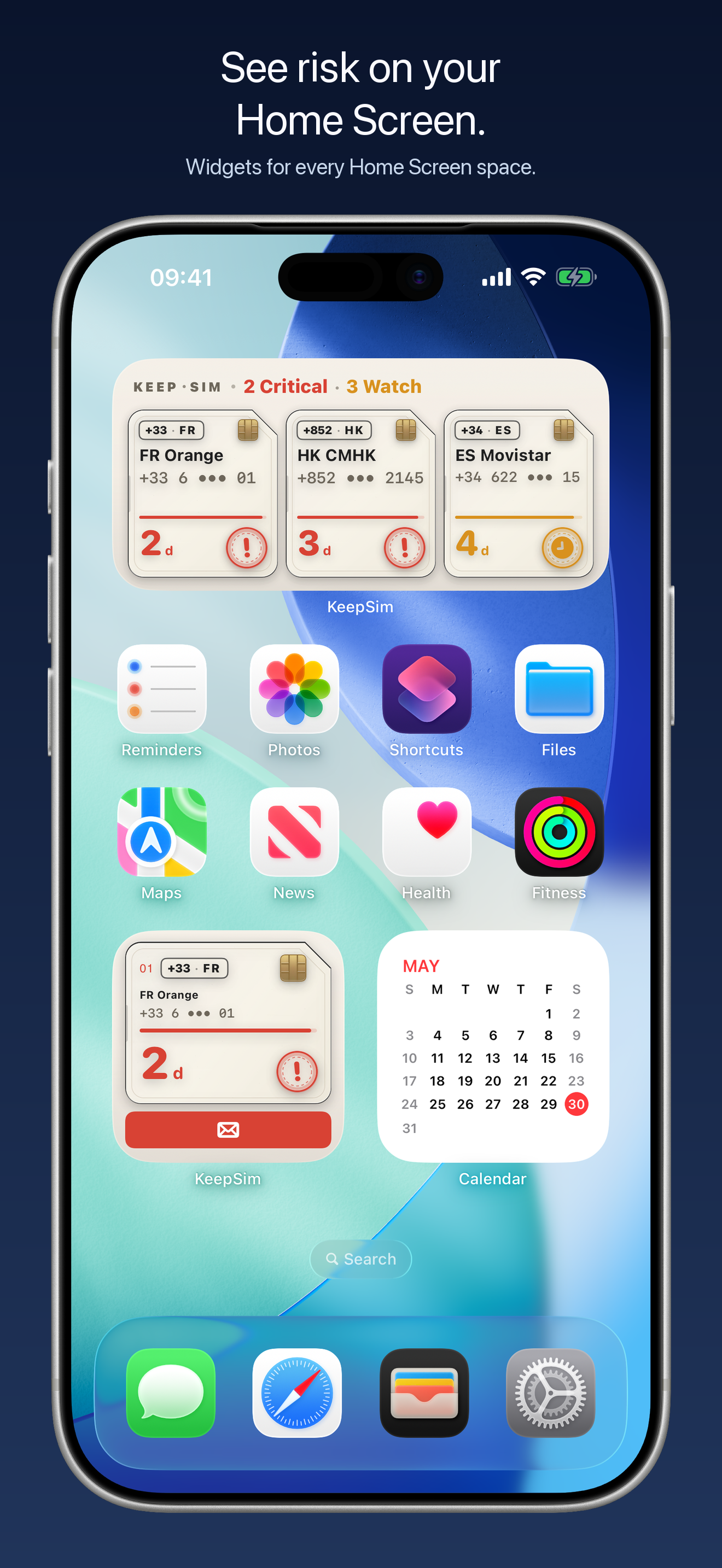
That's what KeepSim does. Every line gets a per-SIM countdown. A Home Screen or Lock Screen widget surfaces whatever is closest to lapsing, so the number you never use stays in view. When one comes due, a single tap opens a prepared keep-alive action instead of leaving you to remember what your carrier needs.
And because these are sensitive numbers, the design matches: KeepSim is local-first — no account, nothing sent to a server, and numbers shown masked by default. The line you're guarding against fraud isn't sitting in someone else's cloud.
Give your invisible SIM a countdown
Track every important number in one place, see the at-risk ones on your Home Screen, and act in one tap — before a missed code costs you a login. Local-first, no account.
Get KeepSim on the App StoreCommon questions
What happens to my bank account if my SIM number is recycled?
If your bank texts codes to a recycled number, you may stop receiving them — and whoever later gets that number could. Recovery without the number can be slow. Keep the number active, or move two-factor to an authenticator app, before the line lapses.
Does losing my number lock me out of WhatsApp?
Not right away. WhatsApp keeps working while installed, but reinstalling or switching phones triggers an SMS re-verification to that number. If the number is gone, so is that path back in.
How do I keep a SIM I never use active?
Most carriers reset the clock with one billable action before the deadline. The hard part is remembering the date for a line you never open — so track each line.
Is it safe to keep my numbers in an app?
It depends on the app. KeepSim is local-first: no account, numbers stay on your device, shown masked by default.
Last reviewed June 2026. Carrier and account-recovery policies change and vary by provider and country — treat this as general guidance and confirm the specifics with your carrier and your bank. KeepSim is a personal reminder tool; it does not provide telecom service, send messages on your behalf, or keep numbers active for you.